

Combed ring-spun cotton is better: why the difference matters
Table of contents
- Why combed ring-spun cotton is better than regular cotton
- What is ring-spun cotton: an explanation of the production process
- Benefits of combed cotton: why the combing process is essential
- Difference between combed and uncombed cotton: what you need to know
- Environmental impact of the combing process: what you need to know
- Caring for combed ring-spun cotton: how to keep your clothes looking good for longer
- Why combed ring-spun cotton is more expensive: what are you paying for?
- Applications: where combed ring-spun cotton is most suitable
Last updated: August 2, 2026
Why combed ring-spun cotton is better than regular cotton is a question many Henk The Tank customers ask. The answer lies in the production process: combed ring-spun cotton removes short fibers and aligns long fibers in parallel, resulting in a softer, stronger, and more durable textile than conventional cotton. This makes a noticeable difference in how your clothing feels, how long it lasts, and how well it can be printed.
What is ring-spun cotton: an explanation of the production process
Ring-spun cotton is made by slowly and tightly twisting cotton fibers together using a ring-shaped mechanism. This creates yarn with greater tensile strength and a smoother surface than open-end yarn (rotor yarn), which is produced more quickly and cheaply but is twisted more loosely and causes more pilling. When you touch a ring-spun cotton shirt, you immediately feel the difference: it feels smoother and more luxurious.
How ring-spun yarn differs from open-end yarn
Open-end yarn is produced with a rotor spinning machine, which rapidly twists cotton fibers together. This is efficient but results in yarn with more loose fibers and pilling. Ring-spun yarn is made on traditional spinning machines where fibers are twisted slowly and tightly, resulting in a better fiber structure and less surface roughness. This process takes up to three times as long, but ensures that the finished product is stronger, lasts longer, and retains color better.
Benefits of combed cotton: why the combing process is essential
The combing process removes short fibers and aligns long fibers in parallel before the yarn is twisted. When you combine combed and ring-spun cotton, you get textiles that are superior to either process alone: softer, stronger, more colorfast, and longer-lasting.
Less pilling and a longer lifespan
Pilling occurs when short fibers become loose. Combed cotton removes these fibers, resulting in far less pilling, even after dozens of washes. Studies show that combed cotton is 20–30% stronger than uncombed cotton, meaning seams are less likely to tear and the fabric is less likely to thin out.
Better printability and color intensity
Combed cotton has a much smoother surface, which means ink adheres better and prints more vividly. This smoothness also improves color intensity: when you dye a shirt, the dye penetrates more deeply and stays fixed better. Colors remain vibrant for months, while cheaper alternatives quickly become dull.
Difference between combed and uncombed cotton: what you need to know
Uncombed cotton contains many short fibers that do not bind well together, resulting in a rougher surface, more pilling, and faster wear. Combed cotton contains only long fibers that lie perfectly parallel and bind strongly together.
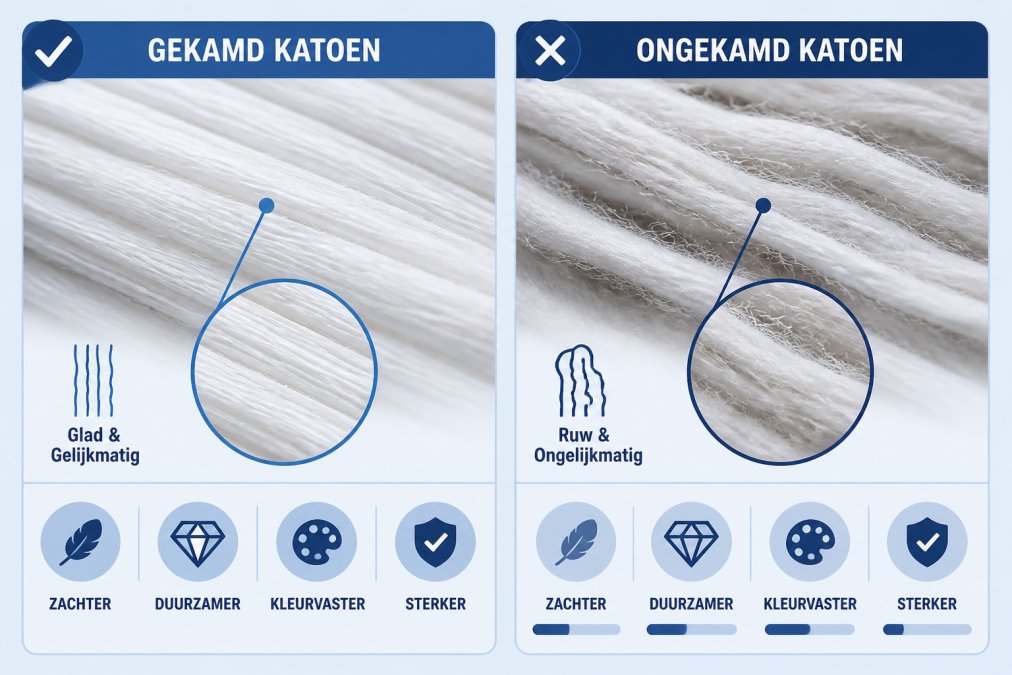
Fiber structure and surface smoothness
Under a microscope, combed cotton fibers lie parallel to one another, smooth and well aligned. Uncombed cotton looks like a chaotic tangle of fibers pointing in every direction. This surface smoothness determines how the fabric feels, how well ink adheres, and how quickly it wears out. Smooth surfaces have less friction, which means fibers are less likely to come loose. Combed cotton also has greater fiber consistency: all the fibers have similar strength and length, resulting in uniform yarn.
Tensile strength and durability comparison
Combed ring-spun cotton has 25–35% greater tensile strength than uncombed open-end cotton. This means seams are less likely to tear, the fabric is less likely to thin out, and the shirt lasts longer.
| Property | Combed ring-spun | Uncombed open-end | Difference |
|---|---|---|---|
| Tensile strength | High | Low | +30% |
| Pilling | Minimal | High | -80% |
| Lifespan | 3–5 years | 1–2 years | +150% |
| Surface smoothness | Smooth | Rough | Clearly visible |
| Color intensity | Vibrant | Dull | Stays looking good for longer |
Environmental impact of the combing process: what you need to know
Combing removes short fibers, but they are not discarded. They are used for filling, insulation material, or further processing. Although the combing process requires more energy and water, combed cotton is likely better for the environment over its entire life cycle because the product lasts much longer and does not need to be replaced as often. Many sustainable fashion brands choose combed ring-spun cotton for this reason.
Caring for combed ring-spun cotton: how to keep your clothes looking good for longer
Proper care significantly extends its lifespan. Wash in cold water (below 30°C) or lukewarm water (30–40°C) to protect the fibers and colors. Air-drying is best; hang your shirt on a drying rack or clothesline. If you must use a dryer, set it to a low temperature.
Wash dark and light garments separately to prevent discoloration. Use a laundry bag for your shirts to prevent worn seams, and set your washing machine to a delicate cycle.
Why combed ring-spun cotton is more expensive: what are you paying for?
You pay for better cotton fibers (only the longest are used), the combing process itself (an extra step that takes time and energy), and ring-spun spinning (three times as long as open-end spinning). Above all, you pay for quality: a €17–22 shirt that lasts three years is cheaper than three €10 shirts that each last only one year. Henk The Tank chooses combed ring-spun cotton because we want our customers to have shirts that last a long time, feel good, and look good.
Applications: where combed ring-spun cotton is most suitable
Combed ring-spun cotton is used wherever quality, comfort, and durability matter.
Premium T-shirts and bedding
Premium T-shirts are the most obvious application. Henk The Tank offers several shirts made from combed ring-spun cotton, such as our [HTT Streetwear T-shirt](https://henkthetank.nl/products/htt-streetwear-t-shirt) (€17.00) and HTT Anonymous Streetwear T-Shirt (€19.50). These shirts are made from 100% combed ring-spun cotton and feel good immediately. Bedding made from this quality material feels more luxurious and lasts much longer, stays soft after many washes, and does not shrink.


Sportswear and loungewear
Sportswear requires fabric with good moisture-wicking properties that is also comfortable. Combed ring-spun cotton is ideal because it is breathable, feels good against the skin, and is strong enough for intense exercise. Loungewear also benefits from combed ring-spun cotton because it is softer and lasts longer. Our Emma's crop top (€17.00) is made from 100% combed cotton, making it exceptionally soft.

| Applications | Why Combed Ring-Spun | Benefits |
|---|---|---|
| Premium T-shirts | Softness and durability | Stays looking good longer |
| Bedding | Comfort and durability | Feels more luxurious |
| Sportswear | Strength and moisture wicking | Lasts longer |
| Loungewear | Softness and comfort | Pleasant for everyday wear |
Why combed ring-spun cotton is better comes down to three things: it feels better, looks better, and lasts much longer. At Henk The Tank, we use combed ring-spun cotton in our premium collections because we want you to have shirts you can wear for years. With our 2-year EU warranty, you are also protected against manufacturing defects. Discover our collection today and experience the difference that genuine quality makes.
Frequently Asked Questions
What is the difference between combed and ring-spun cotton?
Combed cotton and ring-spun cotton are two different processes. Ring-spun cotton refers to how the yarn is twisted, resulting in stronger, softer yarn. Combed cotton describes a processing step in which short fibers and impurities are removed. When both processes are combined, you get the best quality: soft, strong, durable textile fibers with minimal pilling.
Why is combed ring-spun cotton better for printing?
Combed cotton has a smoother surface because short fibers are removed. This provides better printability: prints adhere better, colors are more intense, and the design wears out less quickly. The regular fiber structure of ring-spun yarn enhances this effect even further, resulting in prints that can withstand multiple wash cycles without cracking or fading.
Does combed ring-spun cotton shrink more than other cotton?
No, combed ring-spun cotton actually shrinks less than uncombed cotton. The combing process removes impurities that can contribute to uneven shrinkage. Ring-spun yarn also has greater tensile strength, which means the fibers retain their shape better after washing. With the right washing temperature (30–40°C) and by avoiding high drying heat, you can minimize shrinkage even further.
Is combed ring-spun cotton really more durable than regular cotton?
Yes, combed ring-spun cotton lasts much longer. The combing process removes weak short fibers that wear out and pill more quickly. Ring-spun yarn has greater tensile strength, so the seams and fabric are stronger. Garments made from combed ring-spun cotton retain their shape, color, and softness through hundreds of wash cycles, while regular cotton wears out and fades more quickly.
How do I properly care for combed ring-spun cotton clothing?
Wash at 30–40°C with similarly colored items to prevent fading. Use mild detergent and avoid bleach. Air-dry rather than tumble-dry to prevent shrinkage. If you use a dryer, choose a low-temperature cycle. Iron at a low to medium temperature. These precautions help keep your garments looking great for years and preserve the softness of the textile fibers.
This article was written using GrandRanker